




 admin
admin 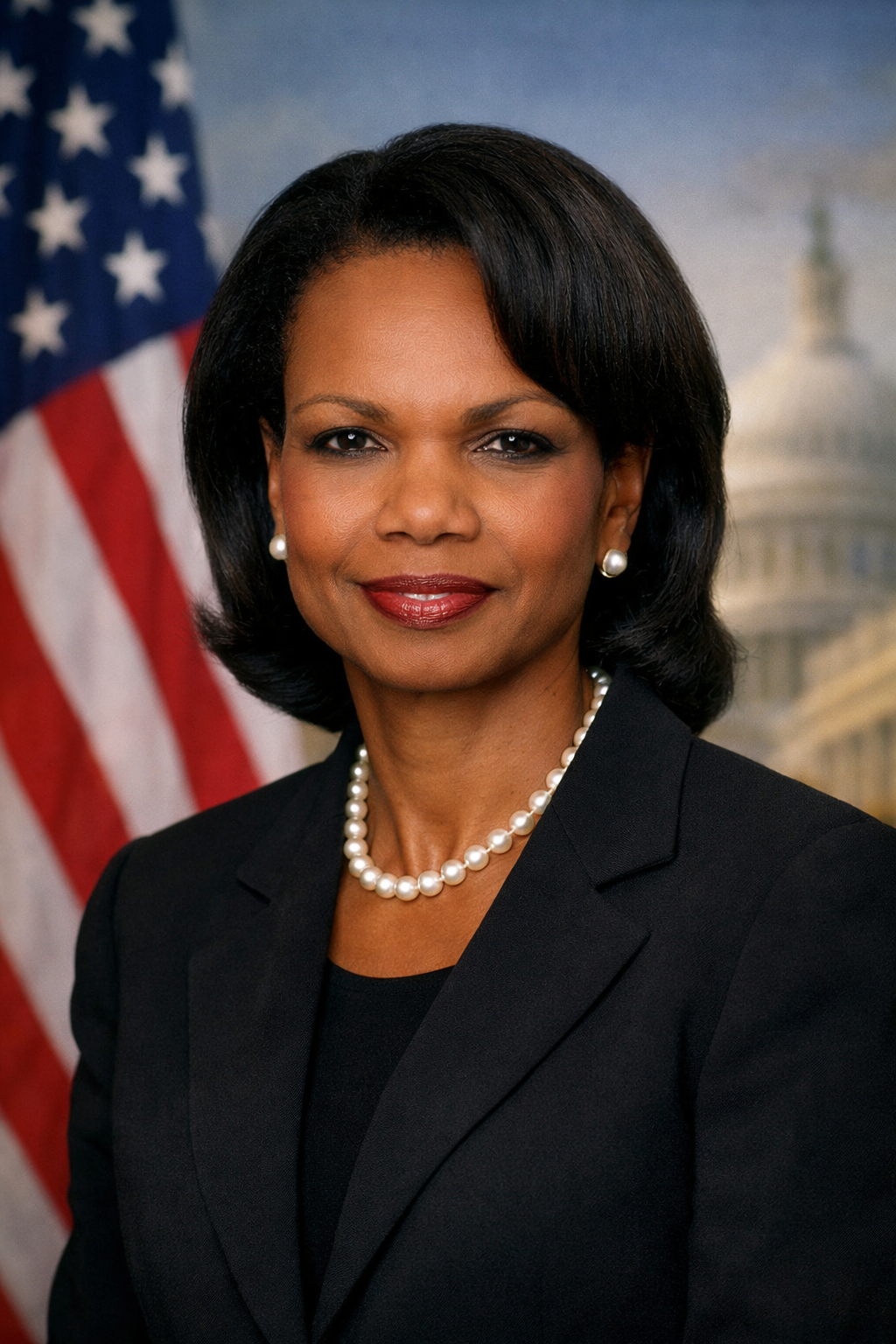
“From segregated Birmingham to the center of global diplomacy, Condoleezza Rice didn’t just enter history — she rewrote it.”
In the corridors of global power, titles like President and Secretary of State carry enormous weight. But in January 2005, Condoleezza Rice — an academic, a strategist, a child of segregated Birmingham — stepped into history as the first African-American woman to serve as the United States Secretary of State. It was a moment that forever altered the landscape of American leadership.
Her appointment didn’t just break a glass ceiling — it shattered stereotypes and reimagined the possibilities for women and people of color in global diplomacy.
From the Jim Crow South to the Global Stage
Born on November 14, 1954, in Birmingham, Alabama, Rice’s early life unfolded against the backdrop of segregation and racial tension. Her parents — her mother a schoolteacher, her father a Presbyterian minister and guidance counselor — instilled in her a fierce commitment to education and self-determination.
Rice didn’t just excel — she soared. Her academic journey led her to earn a Ph.D. in political science, specializing in Soviet and Eastern European studies, at a time when few African-American women had the opportunity to pursue such advanced scholarship.
The Scholar Turned Strategist
Rice’s intellectual rigor would first blossom in academia. She rose through the ranks at Stanford University, where she ultimately became provost — the institution’s first woman and first African-American in that role.
Her academic brilliance attracted attention beyond the ivory tower. When President George W. Bush took office in 2001, he tapped Rice as National Security Advisor — another first for an African-American woman. In this position, she helped guide U.S. strategy in the wake of the September 11 attacks, navigating one of the most consequential periods in modern American security policy.
A Historic Rise: Secretary of State
On a winter day in January 2005, Rice stood ready to assume the role that would define her public legacy. Sworn in as the 66th Secretary of State, she became the first African-American woman to hold the presidency’s highest diplomatic post.
The significance was unmistakable. In a nation still wrestling with its history of racial and gender exclusion, Rice’s appointment was at once groundbreaking and symbolic — a testament to how far the country had come, and a reminder of the work still to be done.
Leading on the World Stage
As America’s top diplomat from 2005 to 2009, Rice stood at the helm of U.S. foreign policy during some of the 21st century’s most complex challenges. Her vision emphasized “transformational diplomacy”—a strategy aimed at expanding democratic principles and partnerships around the world.
Her tenure saw:
- Diplomatic engagement across volatile regions.
- Negotiations involving nuclear proliferation concerns.
- Steering U.S. foreign policy amidst war and peace efforts.
Some critics have debated aspects of her policy legacy. Yet no serious observer questions her influence. She helped shape America’s global posture at a pivotal point in history.
Life After the State Department
When her tenure ended in 2009, Rice returned to her academic roots. At Stanford, she continued teaching, writing, and mentoring future leaders.
Her books and speeches reflect a worldview forged by both intellectual depth and real-world experience — a blend rare even among the most accomplished statespeople.
A Legacy Beyond Office
What makes Condoleezza Rice’s story so compelling isn’t just the titles she’s held, but the barriers she dismantled along the way.
She stands as:
- A reminder of the impact of disciplined scholarship.
- A living symbol of what achievement looks like when informed by resilience.
- An inspiration to girls and young women — particularly those of color — who dare to imagine themselves in the highest seats of power.
She didn’t just represent the United States — she helped redefine what American leadership looks like on the world stage.
And in doing so, she reimagined possibility.
COND OLEEZZA RICE: A TIMELINE OF FIRSTS
1954
Born in Birmingham, Alabama, during the height of segregation in the American South.
1974
Earns a bachelor’s degree at just 19 years old, already showing the academic brilliance that would define her career.
1981
Completes a Ph.D. in Political Science, specializing in Soviet and Eastern European affairs — a rare focus for women and African Americans at the time.
1989–1991
Serves on the National Security Council under President George H. W. Bush, advising on the collapse of the Soviet Union.
1993
Becomes Provost of Stanford University, the first woman and first African American to hold the position.
2001
Appointed National Security Advisor by President George W. Bush — another historic first for an African-American woman.
2001–2004
Plays a central role in U.S. national security strategy following the September 11 attacks.
2005
Sworn in as the 66th U.S. Secretary of State, becoming the first African-American woman to serve as America’s top diplomat.
2005–2009
Leads U.S. foreign policy during a defining era, advancing “transformational diplomacy” and managing global crises.
2009–Present
Returns to academia at Stanford University, authors books, delivers global lectures, and remains a leading voice on leadership and diplomacy.
Why She Matters
Condoleezza Rice didn’t just occupy powerful rooms — she changed who those rooms were built for.
Live The Joy Life!
Discover more from JOY FEELINGS
Subscribe to get the latest posts sent to your email.